Everyone who googles “thatched village Japan” ends up at the same place: Shirakawa-go, a UNESCO-listed hamlet in Gifu that now processes tour buses the way an airport processes planes. I almost booked that trip. Then I found out Kyoto Prefecture has its own Miyama thatched village — Kayabuki no Sato — about two hours from Kyoto Station, ninety minutes if you drive, and that most international travelers have never heard of it.
I took the slow train north instead. No queues, no selfie sticks blocking the viewpoint, and at one point the loudest thing in the valley was a river. This is the version of “old Japan” people fly across the world hoping to find, and it’s sitting quietly in the mountains behind Kyoto.
Why the Miyama Thatched Village Beats Shirakawa-go
Kayabuki no Sato (“the thatched village”) is a working farming hamlet of 50 houses in Nantan City, northern Kyoto Prefecture, and 39 of them still wear their thatched roofs — one of the highest concentrations of thatched buildings anywhere in Japan. It was designated a national Important Preservation District for Groups of Traditional Buildings in 1993, the same category of protection Shirakawa-go holds.
To be clear, this isn’t an undiscovered ruin nobody has heard of. Miyama has spent three decades building tourism on its own terms, and in December 2021 the UN’s World Tourism Organization named it one of its Best Tourism Villages. What it hasn’t picked up is an international reputation: the roughly 900,000 people who visit the wider Miyama area each year are overwhelmingly Japanese, which is why the village can be busy on a Sunday and still contain almost no one who speaks your language.
The difference from Shirakawa-go is scale and intent. Shirakawa-go is world-famous and built out for the crowds it receives. Miyama is still, first and foremost, a village where people live. Residents farm the rice paddies between the houses, hang laundry under the eaves, and go about their day while you wander through. There’s no entrance gate and no admission fee — you’re a guest on someone’s street, which is exactly what makes it feel real.
And where Shirakawa-go demands a dedicated multi-hour trip from anywhere, Miyama is a clean day trip from Kyoto City. That it stays this quiet is, frankly, a mystery I’m happy not to solve.
How to Get There
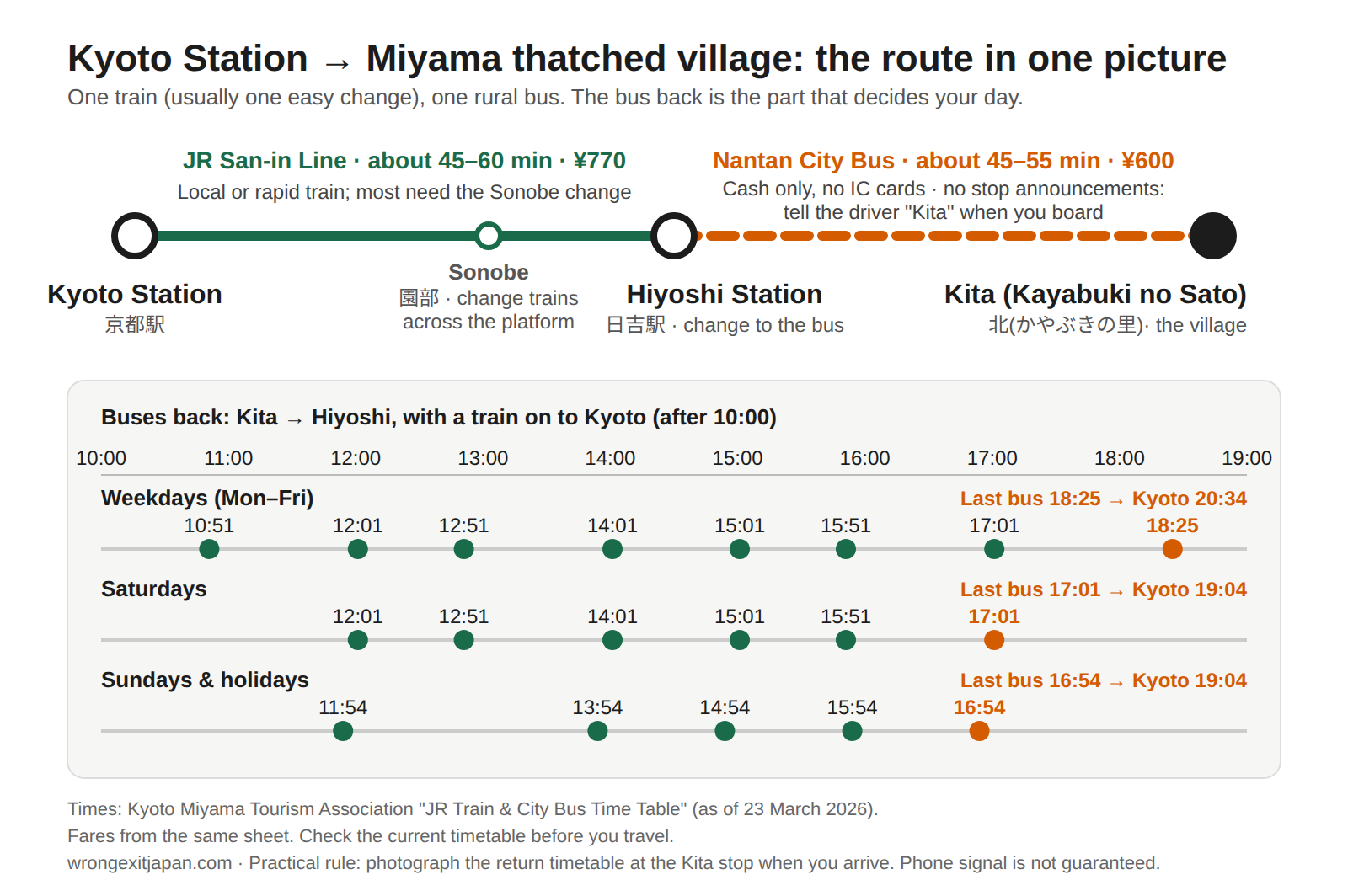
Getting to the Miyama thatched village is the part that filters out the crowds, so pay attention — it’s not hard, it just requires one transfer.
- Kyoto Station → Hiyoshi Station on the JR San-in Line (Sagano Line), about 45–60 minutes and ¥770. Most trains require a transfer at Sonobe — the connecting train waits across the platform.
- Hiyoshi Station → Kita (Kayabuki no Sato) on the Nantan City Bus, about 45–55 minutes, ¥600 one way, cash only (IC cards don’t work). There are no stop announcements, so tell the driver “Kita” when you get on.
Budget about two hours door to door from Kyoto Station, which is what the local tourism association quotes and what it actually takes once you’ve waited for the bus.
If you’re planning to hop between stops in the Miyama area, Nantan buses sell a 1-day pass for ¥1,200 and a 2-day pass for ¥1,500, which pays for itself on the round trip alone.
Two practical warnings. First, the direct sightseeing bus from Sonobe Station (the Keihan Kyoto Kotsu “Kyoto–Miyama Line”) is not operating in 2026, so ignore older guides that route you that way. Second, buses out of Miyama are infrequent — screenshot the return timetable at the bus stop when you arrive, because your phone signal is not guaranteed and the next bus may be over an hour away. The last bus back that connects to a train for Kyoto leaves Kita at 18:25 on weekdays, 17:01 on Saturdays and 16:54 on Sundays and holidays (timetable as of March 2026).
Miyama’s own tourism association publishes the current bus timetable and village information in English at Miyama Navi.
If a self-guided trip on rural bus timetables isn’t your idea of a holiday, guided day tours run from both Kyoto and Osaka — more on that at the end.
Best time to go: Every season works here, but the winter illumination in late January is the one dated event worth planning around — see below. May’s fresh green rice paddies and November’s autumn color are the safest bets for photographs. Which season you pick changes this trip more than it changes most — see the best time to visit Kansai before you lock in dates.
What to Do in the Village
The Miyama thatched village itself is the sight — plan for a slow half day of walking. Within that, three things are worth seeking out.
Climb to the shrine viewpoint. Paths lead uphill behind the houses toward the small village shrine, and from there you get the classic composition: dark thatched roofs stacked against forested mountains, rice paddies in the foreground. It’s the photo you came for, and there’s rarely anyone in it.
The Little Indigo Museum. Indigo artist Shindo Hiroyuki bought the village’s largest thatched farmhouse — built in 1796 for the hereditary village headman — moved his family in, and turned it into a working dye studio with a museum in the attic. You can look into the studio where the indigo vats are sunk into the floor, then go upstairs to a rotating selection from his collection of hundreds of indigo textiles gathered worldwide. Admission ¥300, open 10:00–17:00, closed Thursdays and Fridays (except national holidays) and from late December to early March.
Miyama Folk Museum. A reconstructed thatched farmhouse showing how families actually lived under these roofs — tools, hearth and all. Open 10:00–16:00, closed Mondays, admission ¥300. It burned down in 2000 and was rebuilt by the community, which leads to the village’s strangest spectacle:
Bonus, if you time it right: twice a year (typically May 20 and December 1, at 13:30) the village tests its fire-prevention system, and 62 water cannons hidden in little hut-shaped boxes all fire at once, throwing arcs of water over every thatched roof simultaneously. It exists because of that 2000 fire, and it looks like the village is performing a synchronized fountain show. Dates can shift year to year, and on drill days the car park goes to advance reservation only, so check before you go.
Once a year the village holds its Winter Lantern Festival (Fuyu Toro) — thatched roofs lit by lane lanterns and LED tōrō, and the only eight days of the year Kayabuki no Sato is illuminated at all. The 22nd edition runs January 30 to February 6, 2027. The lanterns are lit from 17:00 to 19:00 each evening, and the parking lot switches to fully pre-booked, pre-paid reservations for the event — bookings are already open, and details are on the official festival page (Japanese). It’s the one week Miyama actually draws a crowd, and it earns it. If you can’t face winter buses, this is the festival the tour companies run special trips for.
Where to Eat
Miyama runs on two local ingredients: buckwheat and milk, and both punch far above what you’d expect from a hamlet this size.
For lunch, Oshokujidokoro Kitamura, right by the village, hand-cuts its soba daily from Miyama-grown buckwheat, stone-milled on site. Expect a set meal in the ¥1,000–1,500 range. For dessert, Miyama no Megumi Milk Studio (near the Miyama Fureai Plaza bus stop) makes soft-serve from local Miyama milk that people genuinely ride buses for, plus ten-odd gelato flavors. Inside the village itself, Café Milan does homemade pudding from free-range eggs and Miyama milk with a view over the roofs, and Café-gallery Saika serves sweets and soft cream inside a heritage farmhouse.
That’s essentially the complete dining scene — this is a village of fifty houses, not a resort. Options thin out fast after mid-afternoon, so eat lunch before 2 p.m. or pack something.
Practical Tips
Bring cash — this is rural Kyoto, and card acceptance around the Miyama thatched village is spotty. There’s a rest house and small shop near the main parking area, but no convenience store. Toilets are available near the parking lot. If you drive, that lot holds about 100 cars and charges ¥500 per car, which goes toward maintaining the roofs and the landscape; there is no other parking nearby, and vehicles aren’t allowed inside the village itself.
Two rules worth taking seriously. Nearly every thatched building is a private home, so photograph from the lanes and don’t step onto private ground or into the fields. And drones are not allowed — the village asks visitors to refrain from flying or filming with them anywhere in Kayabuki no Sato. One quiet hazard: many of the lanes have open, uncovered irrigation channels along the edge, which are genuinely easy to step into after dark or under snow. Phone coverage is workable but not fast, so download offline maps before you leave Kyoto.
If you want to stay overnight, a handful of thatched farmhouses in the Miyama area operate as guesthouses, and mornings in the valley — mist on the paddies before the day-trippers arrive — are the best argument for it. If you’re working out what a trip like this adds to your daily spend, I break the numbers down in the Kansai travel budget guide.
Pairing idea: Miyama sits between two of my other favorite corners of quiet Kyoto Prefecture. Combine it with Ine’s funaya boat houses for a two-day “hidden Kyoto” loop, and see how to get around Kansai for the transport groundwork — rural bus timetables are exactly the problem that guide exists to solve. If you would rather do it as a day trip from Osaka or Kyoto, Tamba Sasayama is the closest cousin: another basin town an hour or so out where the old buildings are still lived in.
Frequently Asked Questions
Is the Miyama thatched village worth it as a day trip from Kyoto?
Yes, if you start early. The village’s own access page puts it at roughly two hours each way from Kyoto Station, and the last bus out of Kayabuki no Sato toward JR Hiyoshi leaves at 18:25 — there is no late-evening service. Plan around that departure rather than around your energy levels.
How do I get to Kayabuki no Sato without a car?
Take the JR San-in (Sagano) Line from Kyoto Station to JR Hiyoshi, about 45–60 minutes with a transfer at Sonobe on most services, then the Nantan City Bus from Hiyoshi to the village, about 45–55 minutes (cash only). Ignore any guide that routes you on the Keihan Kyoto Kotsu “Kyoto–Miyama Line” direct bus: it did not run in 2026, and the village has confirmed it will not run in 2027 either.
Is there an admission fee for the Miyama thatched village?
No. Kayabuki no Sato has no gate and no entry charge — it is a working hamlet, not an attraction. If you drive, the village asks a parking cooperation fee that goes toward maintaining the roofs and the landscape: ¥500 per car, ¥200 per motorcycle, ¥1,000 for a microbus and ¥2,000 for a full-size coach. The lot is open 9:00–17:00 from April to November and 10:00–16:00 from December to March, and there is genuinely no other parking nearby.
When is the winter illumination, and do I need to book anything?
The 22nd Fuyu Toro runs 30 January to 6 February 2027, and those eight nights are the only time all year the village is lit. Lanterns are on from 17:00 to 19:00 daily. If you are driving, every vehicle needs a prepaid parking reservation — ¥1,500 per car, ¥10,000 per coach, booked and paid online in advance. Bookings opened on 7 September 2026 and close at 15:59 on the day of your visit, or earlier if the lot fills. There is no on-the-day payment and no overflow lot.
Can I fly a drone or photograph the houses?
Photograph freely from the lanes, but not from private ground: nearly every thatched building here is somebody’s home, and the fields between them are working farmland. Drones are prohibited outright — the village asks visitors to refrain from all drone flight and aerial filming anywhere in Kayabuki no Sato. One more thing worth knowing before dark: many lanes have open, uncovered irrigation channels along the edge, and they disappear completely under snow.
Should You Book a Tour?
If the bus logistics put you off, this is one of the rare cases where I’d say a guided day trip earns its price. Day tours to Miyama do run from both Kyoto and Osaka, and the good ones solve exactly the two problems this trip has: they skip the Hiyoshi transfer entirely, and they don’t leave you watching a rural timetable for the last bus out.
For the winter lantern festival specifically, the simplest option is the one run by Miyama’s own tourism association: a chartered bus from the Hachijo exit of Kyoto Station on all eight festival dates, with a local guide’s walk through the village and a ¥1,500 voucher for the festival food stalls built in. Details are on the festival page linked above.
Three things to check before you book anything. First, whether the tour actually stops in Kayabuki no Sato itself rather than passing through the wider Miyama area — some itineraries bundle Miyama with Arashiyama or Amanohashidate and leave you under an hour in the village, which is not enough. Second, whether an English-speaking guide is included or the commentary is Japanese-only. Third, the departure calendar: several of the most appealing options are seasonal — winter illumination departures only run on the festival’s eight dates, and some tours only run on fixed dates with a minimum group size, and are cancelled outright if that number isn’t reached.
Either way — go before everyone else finds out. Shirakawa-go was quiet once, too.